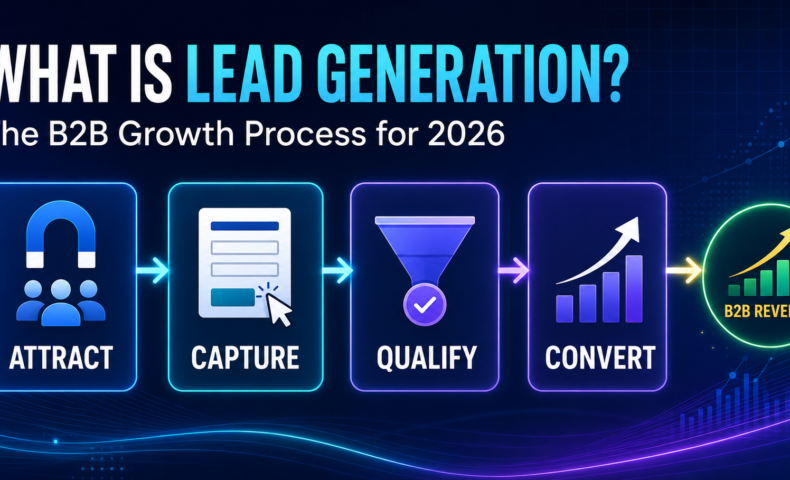
What Is Lead Generation?
A visual, practical guide to attracting the right companies, capturing meaningful buying intent, and turning qualified prospects into predictable B2B revenue.
What Is Lead Generation?
Lead generation is the process of attracting potential customers, capturing their interest, and creating a path toward a sales conversation.
Lead generation in one sentence
Find the right potential customers, earn their attention, identify genuine intent, and help qualified buyers take the next step.
A person may become a lead by requesting a demonstration, submitting a contact form, downloading a report, registering for a webinar, starting a free trial, or asking for pricing.
But effective B2B lead generation is not simply the collection of email addresses. A complete system must determine whether the person belongs to a suitable company, has a relevant problem, and is likely to participate in a real purchasing decision.
Attract
Use SEO, content, advertising, events, partners, and outreach to reach relevant buyers.
Capture
Offer a clear next step that exchanges genuine value for information or intent.
Convert
Qualify, nurture, and support the prospect until a commercial opportunity emerges.
Why Lead Generation Matters for B2B Companies
B2B purchases usually require research, comparison, multiple stakeholders, financial approval, and technical validation. Lead generation helps companies identify and support buyers throughout this longer journey.
Predictable Pipeline
Create a measurable flow of future opportunities rather than depending entirely on referrals.
Efficient Sales
Focus sales time on accounts with stronger fit, intent, and revenue potential.
Market Expansion
Reach new industries, buyer groups, regions, and use cases with focused campaigns.
First-Party Data
Learn what prospects need, which topics matter, and which signals predict a purchase.
Shorter Sales Cycles
Answer important questions before a sales call through education and proof.
Long-Term Trust
Build familiarity before buyers enter an active purchasing cycle.
Quality is more valuable than raw volume
A smaller group of well-matched, high-intent prospects can create more revenue than thousands of unqualified contacts. Measure qualified pipeline—not just form submissions.
The 7-Step Lead Generation Process
Strong lead generation connects strategy, marketing, data, and sales in one continuous system.
Define Your Ideal Customer Profile
Specify the industries, company sizes, locations, technologies, problems, and contract values that represent your best potential customers.
Map the Buying Group
Identify end users, champions, executives, finance, IT, procurement, and other stakeholders who influence the decision.
Attract the Right Audience
Use search, content, social media, advertising, events, partners, communities, referrals, and targeted outreach.
Capture Interest
Offer a demo, assessment, report, calculator, trial, webinar, newsletter, or consultation with a clear value exchange.
Qualify and Score
Combine company fit, engagement, intent, authority, need, timing, and potential customer value.
Nurture the Relationship
Use relevant education, customer proof, follow-up, and product information until the buyer is ready to proceed.
Convert to Pipeline and Revenue
Transfer sales-ready leads with context, validate the opportunity, and guide the buying group through the decision.
Types of B2B Leads
Lead categories help marketing and sales decide what should happen next.
Information Qualified Lead
An early-stage researcher who exchanged information for educational content.
Marketing Qualified Lead
A relevant contact who engaged with marketing but may not yet be ready to buy.
Product Qualified Lead
A prospect whose trial or product behavior suggests meaningful purchase potential.
Sales Qualified Lead
A reviewed prospect with sufficient fit and intent for direct sales engagement.
Service Qualified Lead
An existing customer who has expressed interest in an upgrade or additional service.
Disqualified Lead
A contact who lacks fit, need, authority, viability, or permission for further engagement.
Inbound vs. Outbound Lead Generation
Most high-performing B2B companies combine inbound visibility with selective, well-researched outbound engagement.
Inbound Lead Generation
Help relevant buyers discover you.
- SEO and educational content
- Research reports and guides
- Videos, podcasts, and webinars
- Organic social media
- Calculators and free tools
- Email newsletters and referrals
Compounding visibility, education, trust, and scalable organic acquisition.
Outbound Lead Generation
Proactively reach selected prospects.
- Personalized cold email
- Cold calling
- LinkedIn outreach
- Account-based advertising
- Trade shows and direct mail
- Partner introductions
Reaching narrow markets, strategic accounts, and testing a new offer quickly.
9 Effective B2B Lead Generation Strategies
Choose strategies according to buyer behavior, contract value, sales-cycle length, internal expertise, and available resources.
High-Intent SEO
Create problem, comparison, alternative, pricing, implementation, ROI, and security content for each stage of the buying journey.
Original Research
Publish proprietary benchmarks, surveys, market data, and analysis that buyers and media cannot find elsewhere.
Interactive Tools
Use ROI calculators, assessments, cost estimators, configuration tools, and personalized reports to reveal stronger intent.
Expert-Led Content
Turn internal knowledge, implementation experience, and defensible points of view into useful buyer education.
LinkedIn and Video
Build familiarity with executive insights, short education, product demonstrations, original data, and customer stories.
Account-Based Marketing
Coordinate content, advertising, research, and sales engagement around selected high-value accounts.
Conversion Pages
Clarify the audience, problem, outcome, proof, and next step while reducing unnecessary form friction.
Partner-Led Growth
Work with complementary vendors, consultants, marketplaces, associations, and agencies that already have audience trust.
Re-Engagement
Reconnect with old leads, lost opportunities, inactive trials, and customers when new information creates a relevant reason.
How AI Is Changing Lead Generation in 2026
AI can improve speed, research, analysis, and relevance—but it should not become an excuse to send more generic messages.
How to Qualify B2B Leads
A qualified lead combines three dimensions: fit, intent, and readiness.
1. Product Fit
- Target industry and company size
- Relevant business problem
- Supported region and technology
- Viable contract value
2. Buying Intent
- Pricing or implementation visits
- Demo or proposal request
- Multiple engaged stakeholders
- Active vendor comparison
3. Sales Readiness
- Confirmed need and priority
- Access to decision-makers
- Realistic purchasing process
- Defined timing or event
Marketing and sales must share the same definitions of MQL, SQL, accepted opportunity, and disqualified lead. Otherwise, reports may look successful while producing little revenue.
Lead Generation Metrics That Matter
Do not optimize cost per lead without evaluating qualification, pipeline, revenue, retention, and customer value.
Common Lead Generation Mistakes
Prioritizing quantity over quality
A large contact database is not the same as qualified pipeline. Connect lead reporting to revenue.
Targeting everyone
Broad targeting creates generic messaging. Start with a narrow ideal customer profile and expand from evidence.
Sending every lead to sales
Early researchers often need education. Route only sales-ready leads while nurturing the rest.
Fake personalization
A company name inserted into a template is not useful personalization. Connect verified context to a relevant outcome.
Slow or unclear follow-up
Define ownership, alerts, routing, response standards, and the next action for every high-intent inquiry.
Disconnected data
Connect forms, analytics, advertising, CRM records, pipeline, and revenue to understand what actually works.
Build Your B2B Lead Generation Plan
Choose a Market
Define companies, buyer roles, and high-value problems.
Set a Revenue Goal
Work backward from customers and pipeline—not arbitrary lead volume.
Map the Journey
Cover awareness, comparison, validation, and purchase questions.
Select Channels
Focus on two or three channels that match your buyers and resources.
Create the Offer
Provide a valuable reason to engage, such as a demo, tool, or assessment.
Build the Path
Connect content, landing pages, forms, CRM routing, and follow-up.
Define Qualification
Agree on the fit and behavior required before sales engagement.
Nurture Demand
Educate suitable prospects who are interested but not ready.
Track Revenue
Attribute qualified pipeline, closed revenue, and customer value.
Improve Bottlenecks
Test targeting, traffic, conversion, routing, and sales performance separately.
The goal is not to maximize leads
The goal is to create a repeatable flow of suitable companies with a genuine reason to consider your solution.
Frequently Asked Questions
What is lead generation in simple terms?
Lead generation means finding potential customers, earning their interest, and encouraging them to begin a relationship with your business.
What is B2B lead generation?
B2B lead generation identifies companies and professional buyers who may purchase a product or service from another business.
What is an example of lead generation?
A software company may publish an ROI calculator and invite relevant users to request a personalized assessment. Users who provide business information become leads.
What is the difference between demand generation and lead generation?
Demand generation creates awareness and interest across a market. Lead generation captures identifiable information or intent from potential buyers.
Which lead generation channel is best?
There is no universal best channel. SEO compounds over time, while outbound and account-based marketing can reach selected companies faster. The right combination depends on your market and sales model.
Can AI automate lead generation?
AI can automate research, enrichment, scoring, content adaptation, and routine follow-up. Human oversight remains important for strategy, accuracy, compliance, and high-value relationships.
Lead Generation in 2026: Trust Before Volume
The strongest companies will not be those that send the most automated messages. They will be those that understand a specific market, publish genuinely useful information, identify meaningful buying signals, and coordinate marketing and sales around customer value.
Start with a focused ideal customer profile, create offers that solve real problems, and measure every channel through qualified pipeline and revenue. That is how lead generation becomes a predictable growth system.
Ready to Generate More Qualified B2B Leads?
We help B2B companies combine SEO, high-converting content, data, automation, and targeted outreach into one measurable growth system.
Request a Lead Generation Consultation →What Is Lead Generation?
A visual, practical guide to attracting the right companies, capturing meaningful buying intent, and turning qualified prospects into predictable B2B revenue.
What Is Lead Generation?
Lead generation is the process of attracting potential customers, capturing their interest, and creating a path toward a sales conversation.
Lead generation in one sentence
Find the right potential customers, earn their attention, identify genuine intent, and help qualified buyers take the next step.
A person may become a lead by requesting a demonstration, submitting a contact form, downloading a report, registering for a webinar, starting a free trial, or asking for pricing.
But effective B2B lead generation is not simply the collection of email addresses. A complete system must determine whether the person belongs to a suitable company, has a relevant problem, and is likely to participate in a real purchasing decision.
Attract
Use SEO, content, advertising, events, partners, and outreach to reach relevant buyers.
Capture
Offer a clear next step that exchanges genuine value for information or intent.
Convert
Qualify, nurture, and support the prospect until a commercial opportunity emerges.
Why Lead Generation Matters for B2B Companies
B2B purchases usually require research, comparison, multiple stakeholders, financial approval, and technical validation. Lead generation helps companies identify and support buyers throughout this longer journey.
Predictable Pipeline
Create a measurable flow of future opportunities rather than depending entirely on referrals.
Efficient Sales
Focus sales time on accounts with stronger fit, intent, and revenue potential.
Market Expansion
Reach new industries, buyer groups, regions, and use cases with focused campaigns.
First-Party Data
Learn what prospects need, which topics matter, and which signals predict a purchase.
Shorter Sales Cycles
Answer important questions before a sales call through education and proof.
Long-Term Trust
Build familiarity before buyers enter an active purchasing cycle.
Quality is more valuable than raw volume
A smaller group of well-matched, high-intent prospects can create more revenue than thousands of unqualified contacts. Measure qualified pipeline—not just form submissions.
The 7-Step Lead Generation Process
Strong lead generation connects strategy, marketing, data, and sales in one continuous system.
Define Your Ideal Customer Profile
Specify the industries, company sizes, locations, technologies, problems, and contract values that represent your best potential customers.
Map the Buying Group
Identify end users, champions, executives, finance, IT, procurement, and other stakeholders who influence the decision.
Attract the Right Audience
Use search, content, social media, advertising, events, partners, communities, referrals, and targeted outreach.
Capture Interest
Offer a demo, assessment, report, calculator, trial, webinar, newsletter, or consultation with a clear value exchange.
Qualify and Score
Combine company fit, engagement, intent, authority, need, timing, and potential customer value.
Nurture the Relationship
Use relevant education, customer proof, follow-up, and product information until the buyer is ready to proceed.
Convert to Pipeline and Revenue
Transfer sales-ready leads with context, validate the opportunity, and guide the buying group through the decision.
Types of B2B Leads
Lead categories help marketing and sales decide what should happen next.
Information Qualified Lead
An early-stage researcher who exchanged information for educational content.
Marketing Qualified Lead
A relevant contact who engaged with marketing but may not yet be ready to buy.
Product Qualified Lead
A prospect whose trial or product behavior suggests meaningful purchase potential.
Sales Qualified Lead
A reviewed prospect with sufficient fit and intent for direct sales engagement.
Service Qualified Lead
An existing customer who has expressed interest in an upgrade or additional service.
Disqualified Lead
A contact who lacks fit, need, authority, viability, or permission for further engagement.
Inbound vs. Outbound Lead Generation
Most high-performing B2B companies combine inbound visibility with selective, well-researched outbound engagement.
Inbound Lead Generation
Help relevant buyers discover you.
- SEO and educational content
- Research reports and guides
- Videos, podcasts, and webinars
- Organic social media
- Calculators and free tools
- Email newsletters and referrals
Compounding visibility, education, trust, and scalable organic acquisition.
Outbound Lead Generation
Proactively reach selected prospects.
- Personalized cold email
- Cold calling
- LinkedIn outreach
- Account-based advertising
- Trade shows and direct mail
- Partner introductions
Reaching narrow markets, strategic accounts, and testing a new offer quickly.
9 Effective B2B Lead Generation Strategies
Choose strategies according to buyer behavior, contract value, sales-cycle length, internal expertise, and available resources.
High-Intent SEO
Create problem, comparison, alternative, pricing, implementation, ROI, and security content for each stage of the buying journey.
Original Research
Publish proprietary benchmarks, surveys, market data, and analysis that buyers and media cannot find elsewhere.
Interactive Tools
Use ROI calculators, assessments, cost estimators, configuration tools, and personalized reports to reveal stronger intent.
Expert-Led Content
Turn internal knowledge, implementation experience, and defensible points of view into useful buyer education.
LinkedIn and Video
Build familiarity with executive insights, short education, product demonstrations, original data, and customer stories.
Account-Based Marketing
Coordinate content, advertising, research, and sales engagement around selected high-value accounts.
Conversion Pages
Clarify the audience, problem, outcome, proof, and next step while reducing unnecessary form friction.
Partner-Led Growth
Work with complementary vendors, consultants, marketplaces, associations, and agencies that already have audience trust.
Re-Engagement
Reconnect with old leads, lost opportunities, inactive trials, and customers when new information creates a relevant reason.
How AI Is Changing Lead Generation in 2026
AI can improve speed, research, analysis, and relevance—but it should not become an excuse to send more generic messages.
How to Qualify B2B Leads
A qualified lead combines three dimensions: fit, intent, and readiness.
1. Product Fit
- Target industry and company size
- Relevant business problem
- Supported region and technology
- Viable contract value
2. Buying Intent
- Pricing or implementation visits
- Demo or proposal request
- Multiple engaged stakeholders
- Active vendor comparison
3. Sales Readiness
- Confirmed need and priority
- Access to decision-makers
- Realistic purchasing process
- Defined timing or event
Marketing and sales must share the same definitions of MQL, SQL, accepted opportunity, and disqualified lead. Otherwise, reports may look successful while producing little revenue.
Lead Generation Metrics That Matter
Do not optimize cost per lead without evaluating qualification, pipeline, revenue, retention, and customer value.
Common Lead Generation Mistakes
Prioritizing quantity over quality
A large contact database is not the same as qualified pipeline. Connect lead reporting to revenue.
Targeting everyone
Broad targeting creates generic messaging. Start with a narrow ideal customer profile and expand from evidence.
Sending every lead to sales
Early researchers often need education. Route only sales-ready leads while nurturing the rest.
Fake personalization
A company name inserted into a template is not useful personalization. Connect verified context to a relevant outcome.
Slow or unclear follow-up
Define ownership, alerts, routing, response standards, and the next action for every high-intent inquiry.
Disconnected data
Connect forms, analytics, advertising, CRM records, pipeline, and revenue to understand what actually works.
Build Your B2B Lead Generation Plan
Choose a Market
Define companies, buyer roles, and high-value problems.
Set a Revenue Goal
Work backward from customers and pipeline—not arbitrary lead volume.
Map the Journey
Cover awareness, comparison, validation, and purchase questions.
Select Channels
Focus on two or three channels that match your buyers and resources.
Create the Offer
Provide a valuable reason to engage, such as a demo, tool, or assessment.
Build the Path
Connect content, landing pages, forms, CRM routing, and follow-up.
Define Qualification
Agree on the fit and behavior required before sales engagement.
Nurture Demand
Educate suitable prospects who are interested but not ready.
Track Revenue
Attribute qualified pipeline, closed revenue, and customer value.
Improve Bottlenecks
Test targeting, traffic, conversion, routing, and sales performance separately.
The goal is not to maximize leads
The goal is to create a repeatable flow of suitable companies with a genuine reason to consider your solution.
Frequently Asked Questions
What is lead generation in simple terms?
Lead generation means finding potential customers, earning their interest, and encouraging them to begin a relationship with your business.
What is B2B lead generation?
B2B lead generation identifies companies and professional buyers who may purchase a product or service from another business.
What is an example of lead generation?
A software company may publish an ROI calculator and invite relevant users to request a personalized assessment. Users who provide business information become leads.
What is the difference between demand generation and lead generation?
Demand generation creates awareness and interest across a market. Lead generation captures identifiable information or intent from potential buyers.
Which lead generation channel is best?
There is no universal best channel. SEO compounds over time, while outbound and account-based marketing can reach selected companies faster. The right combination depends on your market and sales model.
Can AI automate lead generation?
AI can automate research, enrichment, scoring, content adaptation, and routine follow-up. Human oversight remains important for strategy, accuracy, compliance, and high-value relationships.
Lead Generation in 2026: Trust Before Volume
The strongest companies will not be those that send the most automated messages. They will be those that understand a specific market, publish genuinely useful information, identify meaningful buying signals, and coordinate marketing and sales around customer value.
Start with a focused ideal customer profile, create offers that solve real problems, and measure every channel through qualified pipeline and revenue. That is how lead generation becomes a predictable growth system.
Ready to Generate More Qualified B2B Leads?
We help B2B companies combine SEO, high-converting content, data, automation, and targeted outreach into one measurable growth system.
Request a Lead Generation Consultation →What Is Lead Generation?
A visual, practical guide to attracting the right companies, capturing meaningful buying intent, and turning qualified prospects into predictable B2B revenue.
What Is Lead Generation?
Lead generation is the process of attracting potential customers, capturing their interest, and creating a path toward a sales conversation.
Lead generation in one sentence
Find the right potential customers, earn their attention, identify genuine intent, and help qualified buyers take the next step.
A person may become a lead by requesting a demonstration, submitting a contact form, downloading a report, registering for a webinar, starting a free trial, or asking for pricing.
But effective B2B lead generation is not simply the collection of email addresses. A complete system must determine whether the person belongs to a suitable company, has a relevant problem, and is likely to participate in a real purchasing decision.
Attract
Use SEO, content, advertising, events, partners, and outreach to reach relevant buyers.
Capture
Offer a clear next step that exchanges genuine value for information or intent.
Convert
Qualify, nurture, and support the prospect until a commercial opportunity emerges.
Why Lead Generation Matters for B2B Companies
B2B purchases usually require research, comparison, multiple stakeholders, financial approval, and technical validation. Lead generation helps companies identify and support buyers throughout this longer journey.
Predictable Pipeline
Create a measurable flow of future opportunities rather than depending entirely on referrals.
Efficient Sales
Focus sales time on accounts with stronger fit, intent, and revenue potential.
Market Expansion
Reach new industries, buyer groups, regions, and use cases with focused campaigns.
First-Party Data
Learn what prospects need, which topics matter, and which signals predict a purchase.
Shorter Sales Cycles
Answer important questions before a sales call through education and proof.
Long-Term Trust
Build familiarity before buyers enter an active purchasing cycle.
Quality is more valuable than raw volume
A smaller group of well-matched, high-intent prospects can create more revenue than thousands of unqualified contacts. Measure qualified pipeline—not just form submissions.
The 7-Step Lead Generation Process
Strong lead generation connects strategy, marketing, data, and sales in one continuous system.
Define Your Ideal Customer Profile
Specify the industries, company sizes, locations, technologies, problems, and contract values that represent your best potential customers.
Map the Buying Group
Identify end users, champions, executives, finance, IT, procurement, and other stakeholders who influence the decision.
Attract the Right Audience
Use search, content, social media, advertising, events, partners, communities, referrals, and targeted outreach.
Capture Interest
Offer a demo, assessment, report, calculator, trial, webinar, newsletter, or consultation with a clear value exchange.
Qualify and Score
Combine company fit, engagement, intent, authority, need, timing, and potential customer value.
Nurture the Relationship
Use relevant education, customer proof, follow-up, and product information until the buyer is ready to proceed.
Convert to Pipeline and Revenue
Transfer sales-ready leads with context, validate the opportunity, and guide the buying group through the decision.
Types of B2B Leads
Lead categories help marketing and sales decide what should happen next.
Information Qualified Lead
An early-stage researcher who exchanged information for educational content.
Marketing Qualified Lead
A relevant contact who engaged with marketing but may not yet be ready to buy.
Product Qualified Lead
A prospect whose trial or product behavior suggests meaningful purchase potential.
Sales Qualified Lead
A reviewed prospect with sufficient fit and intent for direct sales engagement.
Service Qualified Lead
An existing customer who has expressed interest in an upgrade or additional service.
Disqualified Lead
A contact who lacks fit, need, authority, viability, or permission for further engagement.
Inbound vs. Outbound Lead Generation
Most high-performing B2B companies combine inbound visibility with selective, well-researched outbound engagement.
Inbound Lead Generation
Help relevant buyers discover you.
- SEO and educational content
- Research reports and guides
- Videos, podcasts, and webinars
- Organic social media
- Calculators and free tools
- Email newsletters and referrals
Compounding visibility, education, trust, and scalable organic acquisition.
Outbound Lead Generation
Proactively reach selected prospects.
- Personalized cold email
- Cold calling
- LinkedIn outreach
- Account-based advertising
- Trade shows and direct mail
- Partner introductions
Reaching narrow markets, strategic accounts, and testing a new offer quickly.
9 Effective B2B Lead Generation Strategies
Choose strategies according to buyer behavior, contract value, sales-cycle length, internal expertise, and available resources.
High-Intent SEO
Create problem, comparison, alternative, pricing, implementation, ROI, and security content for each stage of the buying journey.
Original Research
Publish proprietary benchmarks, surveys, market data, and analysis that buyers and media cannot find elsewhere.
Interactive Tools
Use ROI calculators, assessments, cost estimators, configuration tools, and personalized reports to reveal stronger intent.
Expert-Led Content
Turn internal knowledge, implementation experience, and defensible points of view into useful buyer education.
LinkedIn and Video
Build familiarity with executive insights, short education, product demonstrations, original data, and customer stories.
Account-Based Marketing
Coordinate content, advertising, research, and sales engagement around selected high-value accounts.
Conversion Pages
Clarify the audience, problem, outcome, proof, and next step while reducing unnecessary form friction.
Partner-Led Growth
Work with complementary vendors, consultants, marketplaces, associations, and agencies that already have audience trust.
Re-Engagement
Reconnect with old leads, lost opportunities, inactive trials, and customers when new information creates a relevant reason.
How AI Is Changing Lead Generation in 2026
AI can improve speed, research, analysis, and relevance—but it should not become an excuse to send more generic messages.
How to Qualify B2B Leads
A qualified lead combines three dimensions: fit, intent, and readiness.
1. Product Fit
- Target industry and company size
- Relevant business problem
- Supported region and technology
- Viable contract value
2. Buying Intent
- Pricing or implementation visits
- Demo or proposal request
- Multiple engaged stakeholders
- Active vendor comparison
3. Sales Readiness
- Confirmed need and priority
- Access to decision-makers
- Realistic purchasing process
- Defined timing or event
Marketing and sales must share the same definitions of MQL, SQL, accepted opportunity, and disqualified lead. Otherwise, reports may look successful while producing little revenue.
Lead Generation Metrics That Matter
Do not optimize cost per lead without evaluating qualification, pipeline, revenue, retention, and customer value.
Common Lead Generation Mistakes
Prioritizing quantity over quality
A large contact database is not the same as qualified pipeline. Connect lead reporting to revenue.
Targeting everyone
Broad targeting creates generic messaging. Start with a narrow ideal customer profile and expand from evidence.
Sending every lead to sales
Early researchers often need education. Route only sales-ready leads while nurturing the rest.
Fake personalization
A company name inserted into a template is not useful personalization. Connect verified context to a relevant outcome.
Slow or unclear follow-up
Define ownership, alerts, routing, response standards, and the next action for every high-intent inquiry.
Disconnected data
Connect forms, analytics, advertising, CRM records, pipeline, and revenue to understand what actually works.
Build Your B2B Lead Generation Plan
Choose a Market
Define companies, buyer roles, and high-value problems.
Set a Revenue Goal
Work backward from customers and pipeline—not arbitrary lead volume.
Map the Journey
Cover awareness, comparison, validation, and purchase questions.
Select Channels
Focus on two or three channels that match your buyers and resources.
Create the Offer
Provide a valuable reason to engage, such as a demo, tool, or assessment.
Build the Path
Connect content, landing pages, forms, CRM routing, and follow-up.
Define Qualification
Agree on the fit and behavior required before sales engagement.
Nurture Demand
Educate suitable prospects who are interested but not ready.
Track Revenue
Attribute qualified pipeline, closed revenue, and customer value.
Improve Bottlenecks
Test targeting, traffic, conversion, routing, and sales performance separately.
The goal is not to maximize leads
The goal is to create a repeatable flow of suitable companies with a genuine reason to consider your solution.
Frequently Asked Questions
What is lead generation in simple terms?
Lead generation means finding potential customers, earning their interest, and encouraging them to begin a relationship with your business.
What is B2B lead generation?
B2B lead generation identifies companies and professional buyers who may purchase a product or service from another business.
What is an example of lead generation?
A software company may publish an ROI calculator and invite relevant users to request a personalized assessment. Users who provide business information become leads.
What is the difference between demand generation and lead generation?
Demand generation creates awareness and interest across a market. Lead generation captures identifiable information or intent from potential buyers.
Which lead generation channel is best?
There is no universal best channel. SEO compounds over time, while outbound and account-based marketing can reach selected companies faster. The right combination depends on your market and sales model.
Can AI automate lead generation?
AI can automate research, enrichment, scoring, content adaptation, and routine follow-up. Human oversight remains important for strategy, accuracy, compliance, and high-value relationships.
Lead Generation in 2026: Trust Before Volume
The strongest companies will not be those that send the most automated messages. They will be those that understand a specific market, publish genuinely useful information, identify meaningful buying signals, and coordinate marketing and sales around customer value.
Start with a focused ideal customer profile, create offers that solve real problems, and measure every channel through qualified pipeline and revenue. That is how lead generation becomes a predictable growth system.
Ready to Generate More Qualified B2B Leads?
We help B2B companies combine SEO, high-converting content, data, automation, and targeted outreach into one measurable growth system.
Request a Lead Generation Consultation →
No comments yet.